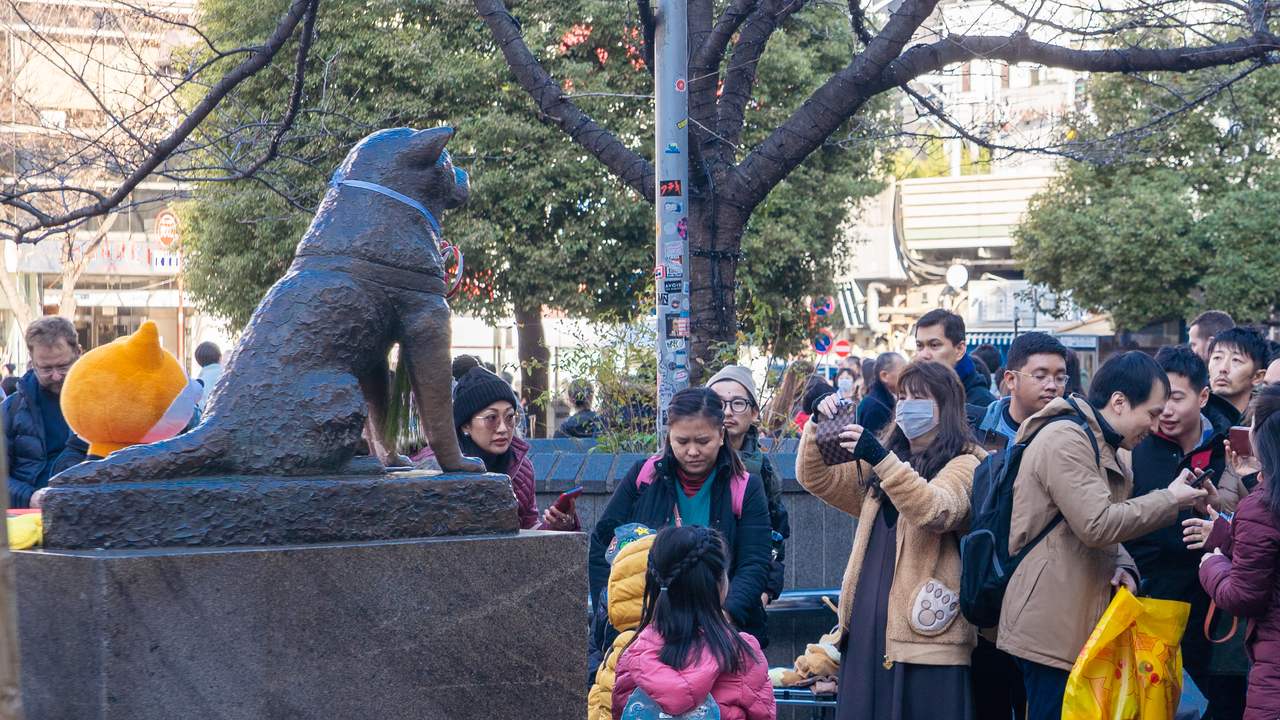
Every dog owner knows the scene. You leave for ten minutes, or ten hours, and when you return there is a dog at the door — sometimes calm, sometimes beside itself — acting as if your arrival is the single most important event in the world. Dogs wait. It is one of the defining facts of living with them. But no dog in history waited like Hachiko, and his story — a true one, nearly a hundred years old now — still explains better than anything why they do it.
A Professor, A Puppy, And A Ritual
Hachiko was an Akita, born in 1923 in Japan's Akita Prefecture and adopted as a puppy by Hidesaburo Ueno, a professor at Tokyo Imperial University. The two settled into a ritual that commuters at Shibuya Station soon came to recognize: each morning, Hachiko walked with the professor to the station and watched him board his train; each evening, the dog returned to the station at the hour the train came in, and the two walked home together.
It lasted a little over a year. In May 1925, Professor Ueno suffered a fatal cerebral hemorrhage while at the university. He never came home. That evening, as always, Hachiko was at the station, waiting at the train — for a man who would not be on it, that day or any day after.
The Wait That Would Not End
Hachiko was given to new homes, but he kept slipping away — and every time, he went back to the station. For nearly a decade, until his own death in March 1935, the dog appeared at Shibuya Station day after day, at the time of the evening train, scanning the crowd of arrivals. Station staff and local people, who had watched the routine begin with the professor, understood what they were seeing. They fed him, looked out for him, and let him keep his post.
In 1932, a newspaper article about the old dog made Hachiko famous across Japan, and people began traveling to see the faithful Akita for themselves. In 1934, a bronze statue of Hachiko was erected outside Shibuya Station — with Hachiko himself present at its unveiling. He died the following year, and his preserved remains are held today by the National Museum of Nature and Science in Tokyo. The statue, rebuilt after the war, still stands at Shibuya; it is one of the most famous meeting points in Japan.
Hachiko was not waiting because he understood death. He was waiting because, for a dog, love is a routine kept faithfully.
So Why Do Dogs Wait?
Hachiko's wait was not a misunderstanding that a smarter animal would have resolved. It was the product of two powerful things modern research can now describe. The first is attachment. Dogs bond to their people in a way that is measurably similar to the bond between a parent and child: in a widely reported 2015 study published in the journal Science, researchers led by Takefumi Kikusui found that when dogs and their owners gaze at each other, oxytocin — the hormone central to bonding and trust — rises in both. It is a feedback loop humans and dogs appear to share, and it helps explain why separation registers so strongly in a dog.
The second is routine. Dogs are extraordinary learners of pattern: the sound of a particular train, the light at a particular hour, the place where a person always appears. Waiting at the station was not a new behavior Hachiko invented after 1925 — it was the habit of a lifetime, performed at the same time, in the same place, with the same expectation. What dogs do not have is our concept of permanent absence. Hachiko could not know the wait was hopeless. From inside the routine, every evening train carried a real possibility.
The Dogs Still Waiting Today
Anyone who works in an animal shelter has met Hachiko's descendants: dogs who watch the door, who keep to the schedule of a person who is gone, who brighten at footsteps that turn out not to be the right ones. Trainers and veterinarians who work with grieving dogs generally give the same advice — keep the remaining routines steady, keep familiar scents and objects around, and give the animal time. The bond that makes a dog wait is the same bond that, eventually, lets it attach to a new routine and new people.
That is why the statue at Shibuya still draws crowds a century later. Hachiko's story is not really about a dog who failed to understand death. It is about devotion in its simplest form: showing up, at the agreed time, in the agreed place, for as long as it takes. We cannot promise our dogs forever. Hachiko reminds us that, as far as they are concerned, they have promised us exactly that.