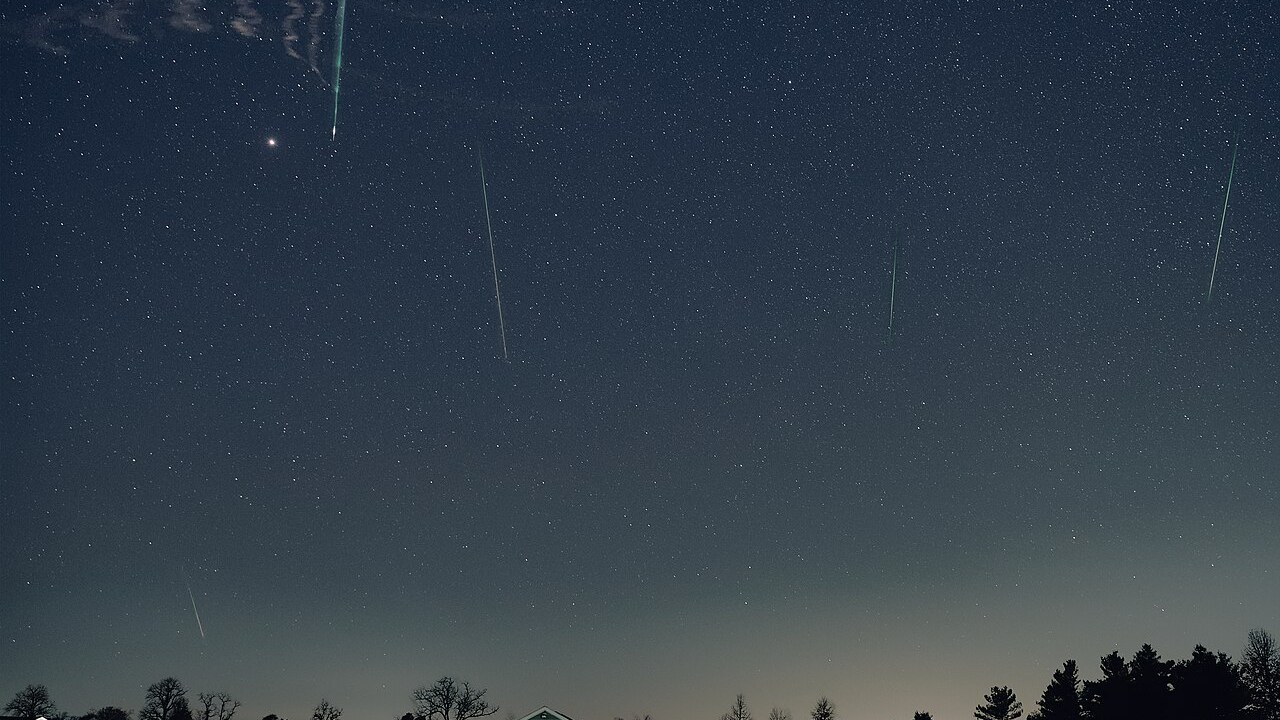
The Leonid meteor shower peaks tonight — and if you step outside in the hours before dawn, you could catch the fastest shooting stars of the year streaking across the sky. The peak falls on the night of November 17 into the morning of November 18, with the best viewing after midnight, once the Moon has set. Just keep your expectations honest: this is a modest shower, not a storm, and most people will count their meteors in single figures, not hundreds.
The Leonids are the debris of Comet 55P/Tempel-Tuttle, which swings around the Sun once every 33 years. Every November, Earth ploughs through the dust the comet left behind, and the grains burn up high in the atmosphere as meteors. Because the comet travels in a retrograde orbit, its dust hits us head-on at about 158,000 miles per hour — the fastest meteors of any annual shower — which is why Leonids are famous for bright, quick streaks that sometimes leave glowing trails hanging in the sky for a few seconds.
Timing matters more than anything tonight. The International Meteor Organization puts the shower's main peak at 11:45 p.m. Universal Time on November 17 — 6:45 p.m. Eastern, 3:45 p.m. Pacific — but that clock time is only half the story. The meteors appear to radiate from the constellation Leo, and Leo does not climb high enough for good viewing until late in the evening. NASA's November skywatching guide points to the early morning hours of November 17 and 18 as the prime window, and the Planetary Society agrees: the night of November 17 into the morning of November 18 is the one to plan for.
As for how many you will see: under a truly dark sky, away from city lights, the Leonids can produce around 15 meteors an hour at their best. NASA is more cautious, noting that rates are often closer to three an hour under dark skies, and most backyard viewers will see fewer still. City lights, haze and a bright Moon all cut the count fast. The Moon reaches its first quarter phase on November 17 and sets around midnight — good timing, since the best viewing starts after it drops below the horizon.
THE STORY SO FAR
November 6 — the Leonid shower becomes active as Earth enters the debris stream left by Comet Tempel-Tuttle.
November 16 into 17 — the first peak night, listed by NASA as the shower's peak, with the best viewing in the hours before dawn.
November 17, 6:45 p.m. Eastern — the International Meteor Organization's nodal peak, the single sharpest moment of the shower.
Tonight into the morning of November 18 — the best viewing window, with the Moon set and the constellation Leo high in the sky.
November 18 before dawn — a second chance if clouds spoil tonight, nearly as good as the first night.
November 30 — the shower fades out for another year.
WHY THE LEONIDS ARE FAMOUS
The Leonids earned their reputation on the night of November 12–13, 1833, when the sky over North America erupted. Estimates put the peak at more than 100,000 meteors an hour, with one count topping 240,000 meteors over nine hours. People woke to what looked like the stars falling. The Lakota reset their calendar to mark it, and the night was later recalled by Abraham Lincoln, Frederick Douglass and Harriet Tubman. Scientists at the time thought meteors were weather — something in the air. A Yale professor named Denison Olmsted collected reports from across the continent, showed the meteors radiated from a point in Leo, and argued they came from a cloud of particles in space. Modern meteor science effectively starts that night.
Great Leonid storms return roughly every 33 years, tied to the comet's orbit — 1866, 1966 and 2001 all produced spectacular displays. 2026 is not one of those years. No storm is forecast, and the models predict only the ordinary annual shower. That is the honest version of tonight: a quiet, beautiful show for those who go looking, not a sky on fire.
HOW TO WATCH TONIGHT
Go dark. The single biggest factor is light pollution — drive away from town if you can, and find a spot with a wide, open view of the sky.
Go late. The best hours are after midnight until dawn, on the mornings of November 17 and 18. The Moon sets around midnight, and Leo climbs higher through the night.
Look east. The meteors seem to fly out of Leo the Lion — find the backward question mark of stars called the Sickle, marked by the bright star Regulus — but do not stare at Leo itself. Watch a wide patch of sky and let the meteors catch your eye.
Leave the telescope at home. Meteors are best seen with the naked eye, and your eyes need 20 to 30 minutes in the dark to fully adjust — every glance at a phone screen resets the clock.
Give it an hour. At 15 meteors an hour under perfect conditions, a five-minute look can easily show nothing. Dress warm, bring a blanket or a reclining chair, and settle in.
WHAT HAPPENS NEXT
If clouds spoil tonight, try again before dawn on November 18 — the second peak morning is nearly as good. After that the shower thins out, ending around November 30. The next big date for skywatchers is the Geminid meteor shower, the year's best, which peaks on the night of December 13 into the 14th. And the Leonids' next storm-class return is years away — the last great displays came in 1866, 1966 and 2001, so tonight's quiet shower is the show on offer, and it is worth an alarm clock.
Step outside after midnight, look east, and wait. The fastest meteors of the year are already falling — you just have to be under a dark sky to see them.