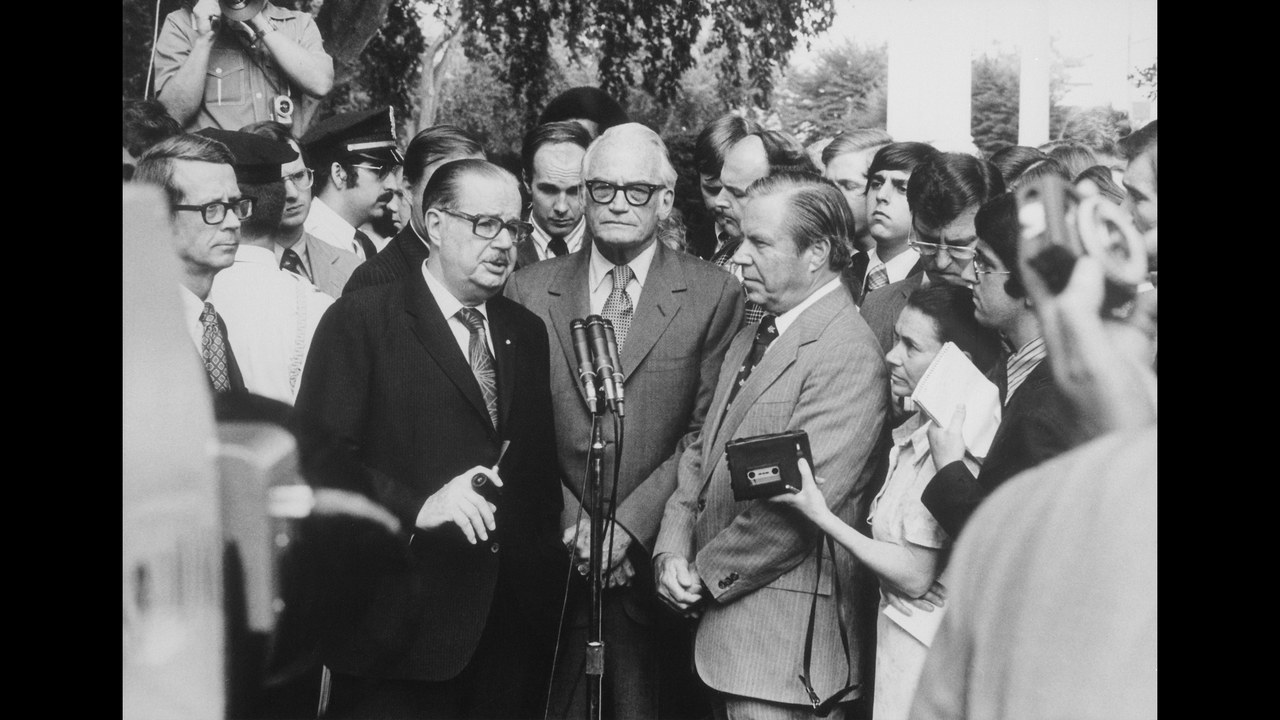
Fifty-three years ago today, on November 17, 1973, Richard Nixon stood before about 400 managing editors of the Associated Press at the Contemporary Resort in Walt Disney World, Orlando, Florida, and said the words that would follow him for the rest of his life: 'Well, I am not a crook.' The press conference was nationally televised, it ran for about an hour, and the line became the most-quoted sentence of the next day's news. But almost everything people remember about the moment is slightly wrong — including what Nixon was actually being asked.
The question came from Joseph Ungaro of the Providence Evening Bulletin, and it was not about the Watergate break-in. It was about Nixon's personal finances and his taxes. Reports had emerged that Nixon, despite a presidential salary of $200,000 a year, had paid just $792 in federal income tax in 1970 and $878 in 1971. The reason was a deduction for donating his vice-presidential papers to the National Archives — a deduction that was legal when the papers were given, but that had been claimed on a deed that was allegedly backdated after the law changed.
Nixon's answer ran 839 words, and the famous line came at the very end of it. He began by saying he had made his mistakes, but that in all his years of public life he had never profited from public service and had earned every cent. He added that he had never obstructed justice. Then he welcomed the examination of his finances, saying people had got to know whether or not their President was a crook — and then, in the sentence that became his political epitaph, he said he was not one.
I made my mistakes, but in all of my years of public life, I have never profited, never profited from public service — I have earned every cent. And in all of my years of public life, I have never obstructed justice. And I think, too, that I could say that in my years of public life, that I welcome this kind of examination, because people have got to know whether or not their President is a crook. Well, I am not a crook. I have earned everything I have got.
The context of the press conference is what made the line so damaging. It came about a month after the Saturday Night Massacre of October 20, 1973, when Nixon fired Special Prosecutor Archibald Cox, who had been investigating Watergate, and Attorney General Elliot Richardson and Deputy Attorney General William Ruckelshaus resigned rather than carry out the order. It came weeks after Vice President Spiro Agnew resigned, in October 1973, over a tax-evasion scandal of his own. The country was watching a president who was losing his cabinet, his vice president and his credibility at the same time — and the line about not being a crook landed on a public that had already stopped believing him.
The taxes turned out to be a real problem, not just a talking point. Nixon later agreed that he owed nearly $432,000 in back taxes and interest, and he repaid it in May 1974. His approval rating, which had been declining for more than a year, kept falling. The broadcaster David Frost, who would interview Nixon after his resignation, later said this was the moment Nixon's fate was sealed — the moment a defensive answer about his taxes became the sentence that defined his presidency.
Less than a year after the Disney World press conference, it was over. Nixon announced his resignation on August 8, 1974, and left office the next day, August 9 — the only president in American history to resign. The line he had delivered in Orlando did not cause his resignation on its own, but it became the shorthand for it: the sentence people quoted when they wanted to explain, in six words, why a president had fallen.
The full transcript of the press conference is public, and it is worth reading in full, because the famous sentence is only the last line of a long, rambling answer — and the rest of the answer shows a president who was trying to defend himself on two fronts at once: his taxes and Watergate. He was answering the first. History remembers him for the second.
THE STORY SO FAR
June 17, 1972 — Five men are arrested breaking into the Democratic National Committee offices at the Watergate complex in Washington, D.C.
October 10, 1973 — Vice President Spiro Agnew resigns over a tax-evasion scandal.
October 20, 1973 — The Saturday Night Massacre: Nixon fires Special Prosecutor Archibald Cox; Attorney General Elliot Richardson and Deputy Attorney General William Ruckelshaus resign.
November 17, 1973 — At a televised press conference at the Contemporary Resort in Walt Disney World, Nixon answers a question about his taxes and says: 'Well, I am not a crook.'
May 1974 — Nixon repays nearly $432,000 in back taxes and interest.
August 8, 1974 — Nixon announces his resignation. He leaves office on August 9, 1974, less than a year after the press conference.
WHAT HAPPENS NEXT
Nothing happens next in the story itself — it ended in 1974. But the line lives on, and every November 17 it comes back, because the date is now a fixed point in American political history. The press conference is one of the most studied moments in the history of the presidency, and the full transcript is publicly available for anyone who wants to read the 839-word answer in full rather than just its last sentence.
The lesson the moment left behind is about the words a president chooses under pressure. Nixon's answer was meant to close a question about his taxes. Instead, it gave the country a sentence it would repeat for the next half-century — a reminder that in politics, the line you say to end a story is often the line the story ends with.