Some claims are modest. This one arrives wearing a crown: the Great Wall of China, it is said, is the only human-made object visible from space — in the grandest version, the single work of human hands that can be seen from the Moon. It is taught in classrooms, printed in trivia books and believed, in one survey of 2,000 adults, by 55% of people. It is also the rare myth that can be settled by simply asking the people who have been up there.
The Claim (And The "Only Object" Version)
Strip the claim to its testable core: an unaided human eye, looking down from space, can pick out the Great Wall — uniquely among our works. The 'only object' flourish is doing heavy lifting, because it converts a question about one structure's visibility into a statement about everything else we have built. Both parts fail, but they fail in instructive ways, and the first failure is a matter of simple geometry.
The Width Problem: A Hair From Two Miles
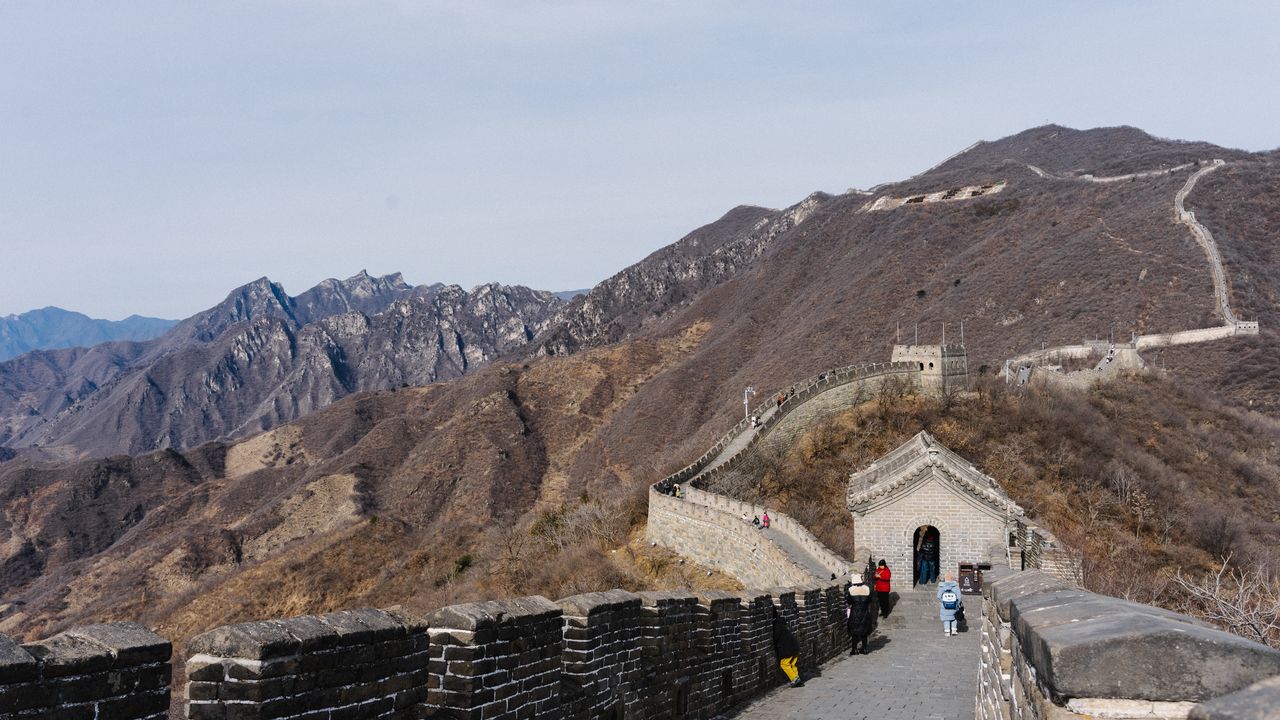
The Wall's fame rests on its length — thousands of miles of fortification snaking across northern China, built and rebuilt across centuries. But length is nearly irrelevant to whether an eye can see something. What matters is width and contrast. The Great Wall is, along most of its course, only about 15 to 30 feet wide — roughly the width of a two-lane road — and it is built largely from the stone and earth of the landscape it crosses, so it blends into that landscape's colors.
The comparison astronomers and astronauts reach for is exact: trying to see the Wall from low Earth orbit is like trying to spot a human hair from about two miles away. From the Moon — roughly a thousand times farther than the space station's orbit — the same claim becomes not difficult but absurd. No astronaut who stood on the Moon or orbited it reported picking out the Wall, or any other specific human-made object. From that distance, on the day side, you see a blue and white and brown planet. Continents, yes. Constructions, no.
The Wall's fame rests on its length. Visibility rests on width — and the Wall is only as wide as a two-lane road.
What Astronauts Actually Said
The space age turned this from speculation into testimony, and the testimony has been consistent for decades: astronauts in low Earth orbit, actively looking, have found the Wall extremely difficult to distinguish with the naked eye — its color merges with the terrain, its width falls below what the eye resolves — while other human works announce themselves plainly. The claim's defenders sometimes retreat to camera lenses, and there the honest nuance lives: with telephoto lenses, favorable light and prior knowledge of exactly where to look, segments of the Wall can indeed be photographed from orbit. But 'a camera can find it if you already know where it is' is a different claim from 'the only object visible from space' — and it is the second claim, the famous one, that is false.
What You CAN See From Orbit
The 'only object' version gets the reality precisely backwards. The human works that do show up from orbit are the ones with width, brightness or contrast: highway networks and airport runways, great bridges, sprawling reservoirs — and above all, at night, cities, whose merged light blooms across whole regions of the dark side of the planet. If a single human signature deserves the superlative from space, it is not a wall. It is light itself: the electric glow of civilization, visible as no fortification could ever be.
It is also worth asking how the claim survived two centuries untested — for the simple reason that, for most of its life, it could not be tested. The idea circulated in print long before spaceflight, in an age when 'visible from the Moon' was a poetic measure no reader could check. By the time astronauts could check, the sentence had a century's head start and the momentum of every textbook that had ever reprinted it.
The claim also flatters the structure it celebrates, which is a powerful survival trait for a myth. The Wall is a genuine wonder of persistence — raised and rebuilt across dynasties, at a cost in labor and lives that staggers historians — and calling it the one human work visible from the heavens feels like the tribute its builders deserve. Myths that make us feel something about a place reliably outcompete corrections that merely inform us about it. It took actual astronauts, looking down with their own eyes and reporting honest disappointment, to begin evening the score — and even now, the tribute version is the one most people can recite.
The Verdict
The Great Wall is one of the most astonishing things humans have ever built, and it does not need a false superlative. From space, the naked eye cannot find it; from the Moon, nothing we have made can be found at all. What our species looks like from up there is not a line of stone. It is a lit-up world at night — which is, in the end, a better boast.