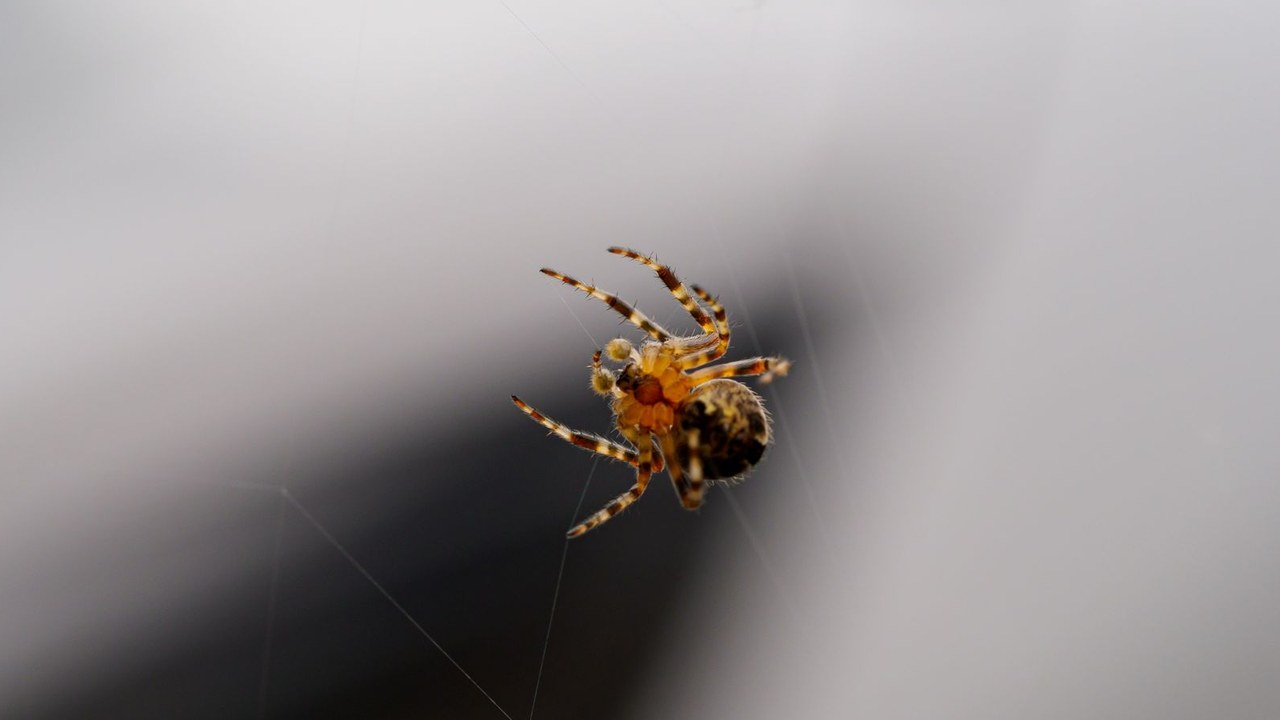
Begin with the claim in its strongest, most familiar form: the average person swallows eight spiders every year, in their sleep, without noticing. The spiders wander in the dark, reach the sleeper's face, and slip past the lips. It is specific, it is vivid, and it is — according to everything science can actually tell us — not a thing that happens.
The Claim Everyone Heard At A Sleepover
Notice first how unstable the number is. Ask around and the toll changes with the teller: four spiders a year, eight spiders a year, ten. Genuine measurements do not do that. Your height does not become a different figure depending on who is describing you — but folklore mutates freely, because nothing anchors it. A statistic that shapeshifts between 4, 8 and 10 is not a statistic. It is a rumor wearing a lab coat.
And the trail behind it is exactly as empty as that suggests. No sleep laboratory has ever reported a swallowed spider. No researcher has ever run the count, for the simple reason that you cannot design a study around an event that does not observably occur. The claim has never been measured — not once, by anyone, anywhere. It has only been repeated.
Why A Spider Would Never
Set the missing evidence aside and test the claim against the animal itself, because the spider's side of the story is where the myth truly collapses. A spider experiences the world overwhelmingly through vibration and air movement. A sleeping human is, from that sensory point of view, a landscape of threats: rhythmic gusts of warm exhaled breath, the low thunder of a heartbeat and snoring transmitted through the mattress, body heat, constant small movements.
House spiders want the opposite of all that. They build in corners, behind furniture, in the undisturbed edges where prey comes to them and nothing large breathes. For a spider, crossing an open bed toward a giant vibrating heat source and then entering its mouth is not a plausible accident; it is a suicide mission against every instinct the animal has. Spider experts make this point with some weariness, having made it for decades: spiders are not drawn to sleeping people. They avoid them, the way prey animals avoid predators — which, in the spider's world, is precisely what we are.
To a spider, a sleeping human is not a cave to explore. It is an earthquake to avoid.
The Origin Story — Which Is Also A Myth
Now for the twist that makes this claim unique among famous falsehoods. You may have heard the satisfying backstory: that the spider statistic was invented on purpose, by a writer demonstrating how easily people believe anything they read in print — and that its worldwide spread proves the point perfectly. It is a wonderful story. It is also, as far as anyone can verify, not established fact.
When fact-checkers went hunting for the original column, the original list of invented 'facts,' the original author — the trail dissolved into the same fog as the claim itself. The invention story is repeated everywhere, cited almost nowhere, and supported by no document anyone has produced. Which means the eight spiders are a double myth: a false statistic, wrapped in an unverified story about the statistic, both believed for the same reason — because each is a good story, confidently told. The claim about spiders fooled us. Then the claim about the claim fooled us again, and the second fooling felt like sophistication. It is the most instructive falsehood on the internet, precisely because even its debunking needs debunking.
What Science Can Actually Say
Honesty about evidence cuts both ways, so here is the precise state of knowledge. Science cannot prove that in all of human history, no spider has ever ended up in any sleeping person's mouth; freak accidents are not disprovable, and no one funds the research. What science can say is everything that matters: there is no evidence for the claim, no mechanism that would make it routine, no measurement behind the number, and a complete behavioral explanation for why spiders stay away. The famous version — average people, every year, eight apiece — is folklore, full stop.
Why does this claim, of all claims, prove so hard to retire? Partly because it is perfectly engineered to spread: short, numerical, faintly disgusting and impossible to falsify at home — you cannot watch yourself sleep, and you would not remember it if it happened. A claim that no listener can personally test is a claim that can live in every bedroom it is told in, forever, charging no rent but a moment's shudder each time it is repeated to a fresh audience of children at a sleepover.
What actually ends up in bedrooms is more mundane: house spiders in their corners, minding their own business, eating the insects you would like even less. The spider in the corner is not a threat rehearsing its approach. It is pest control that you did not have to pay for.
The Verdict
Eight spiders a year is a campfire number — memorable, shudder-inducing and wholly invented, kept alive by repetition and by a too-perfect origin story that does not survive scrutiny either. Sleep easy. The only thing that has been swallowing this claim, year after year, is us.