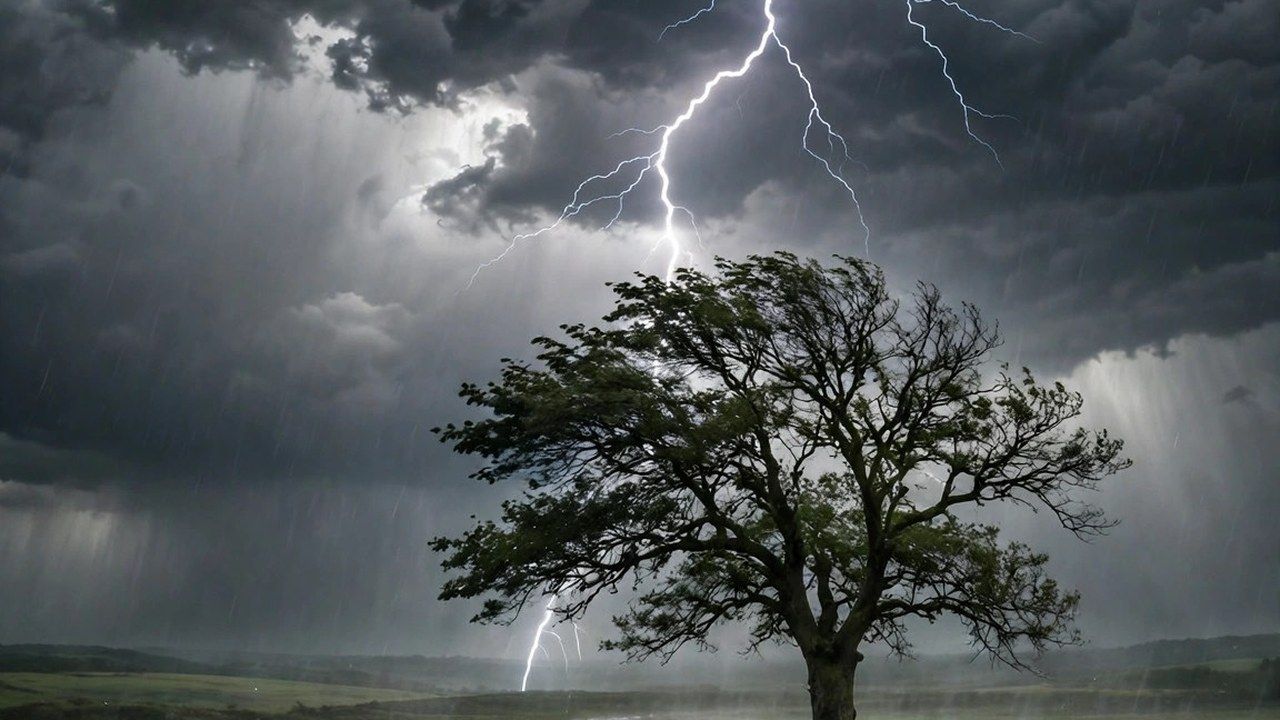
It is said with a shrug, usually after somebody's bad luck, and it wears the costume of a law of nature: lightning never strikes the same place twice. As meteorology, the sentence is not just wrong — it is upside down. The places lightning strikes are, by the physics of the thing, the places it is most likely to strike again. And there is a building in Manhattan that has been disproving the proverb, on the record, for over ninety years.
The Claim
Notice first that the sentence does double duty. As a metaphor, it means: misfortune does not repeat itself, lightning being cast as fate's most random instrument. As a weather statement, it gets quoted by people deciding whether a spot is safe — which is where a proverb stops being charming. The National Weather Service keeps a page of lightning myths for a reason, and this one sits at the top of it. The truth is more interesting than the proverb anyway: lightning is not random at all. It is, in its way, almost conservative — it follows rules, and the rules favor repeats.
The Physics: Lightning Is Lazy, Not Fair
A lightning strike is an electrical discharge hunting for the easiest path between a charged cloud and the ground. 'Easiest' is the whole ballgame. As a storm's charge builds, invisible leaders grope downward from the cloud while answering streamers reach up from the ground's most prominent features — and prominence is measured in height, sharpness and conductivity. The tallest tree, the church steeple, the antenna, the lone golfer's raised club: these are not unlucky objects. They are the shortest route.
Now the myth inverts itself. Whatever made a place the easiest path in the last storm — its height, its point, its metal — is still true in the next storm. Nothing about being struck once makes a tower shorter, duller or less conductive. Repeat strikes are not lightning breaking a rule. They are the rule, applied again.
Lightning does not remember where it struck and move on. It remembers nothing — and the tallest point is still the tallest point tomorrow.
The Buildings That Get Hit Again And Again
Exhibit A stands at 34th Street and Fifth Avenue. The Empire State Building was effectively designed into the role of Manhattan's lightning rod, and it performs it constantly: the building itself states that its antenna is hit by lightning an average of 25 times a year, while the National Weather Service, citing the same phenomenon, puts the figure at 23. The two-count disagreement is a rounding matter; the point is the dozens. In a single busy storm, the building can be struck repeatedly — and its protection systems channel every hit harmlessly to the ground, which is the entire idea.
It has company. Chicago's Willis Tower and the world's other great spires log strikes by the score each year; communications towers and mountaintop installations are hit as a matter of routine engineering. And then there is the human record, which ends the argument about repeat strikes permanently: Roy Sullivan, a former Shenandoah National Park ranger recognized by Guinness World Records, survived being struck by lightning seven separate times. Lightning did not merely strike the same place twice. It struck the same man seven times.
How A Metaphor Became A "Fact"
The proverb's survival trick was the one we keep meeting in this series: a figure of speech, repeated often enough, got promoted into a physical law. 'Lightning never strikes twice' was consolation long before it was meteorology — a way of saying your run of bad luck must be over. But proverbs leak. Repeated by parents, teachers and headline writers, the metaphor shed its figurative license and started being believed as weather science, complete with a false sense of safety that the Weather Service now has to actively correct.
What Actually Keeps You Safe
The real rules are short and genuinely useful. When thunder roars, go indoors — a substantial building or a hard-topped car, and stay there 30 minutes after the last thunder. Get out of and away from water. Avoid isolated trees, open fields' high points, and anything tall and metal you might be holding. And never reason from the proverb: a place that was struck is not 'used up,' a storm's first strike does not clear the area, and lightning can hit miles ahead of the rain. Safety comes from the physics — low, enclosed, and patient — not from folklore's promise that the sky keeps a tally and moves on.
The Verdict
Lightning strikes the same place twice, ten times, twenty-five times a year on one famous building alone — because the sky is not dealing out luck. It is completing a circuit, by the shortest path it can find. Be somewhere else, low and indoors, when it finds it.